
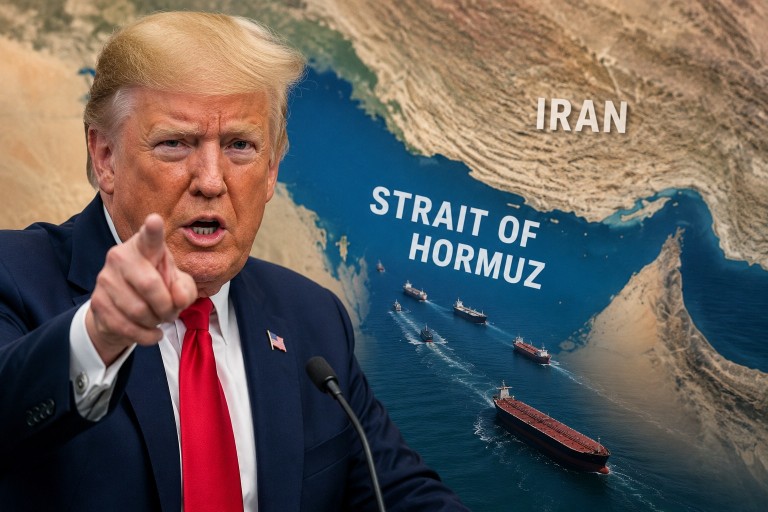
In a bold statement, US President Donald Trump indicated that the United States might soon declare the Strait of Hormuz as its territory, amidst ongoing tensions with Iran. Speaking in New York, Trump suggested this move would follow a US victory over Iran, asserting that the strategic waterway is effectively under US control due to a blockade. The Strait of Hormuz is crucial for global trade, as it facilitates the passage of approximately 20% of the world’s seaborne oil supply. The waterway, positioned between Iran and Oman, has been largely inaccessible since military operations by the US and Israel against Iran began.
Trump’s remarks have sparked uncertainty about whether this signifies a shift in US foreign policy or if it was merely a political maneuver. Responding to the threat, Iran’s Deputy Foreign Minister, Kazem Gharibabadi, dismissed it, stating that Tehran would not yield to US pressure. He emphasized that decisions about the strait’s status remain under Iranian jurisdiction. Meanwhile, Iranian Foreign Minister Abbas Araqchi confirmed that Iran has not decided to engage in negotiations with Washington, noting that any current communication via intermediaries like Qatar and Pakistan does not amount to formal discussions.
Iran has outlined several prerequisites for the resumption of shipping through the Strait of Hormuz. These include compensation for damages inflicted by the conflict, lifting of sanctions, and the release of blocked Iranian assets. The impasse over this vital maritime route has led to increased fuel prices, creating additional financial strain on consumers. President Trump defended these rising costs, arguing that Americans are bearing the burden to prevent Iran from acquiring nuclear capabilities.
The ongoing stalemate surrounding the Strait of Hormuz continues to pose significant concerns for global energy markets and economic stability. As the situation develops, the potential impact on worldwide energy supplies remains a critical point of focus for international observers and stakeholders. The broader implications of the conflict could have far-reaching effects on economic conditions beyond the immediate region.