
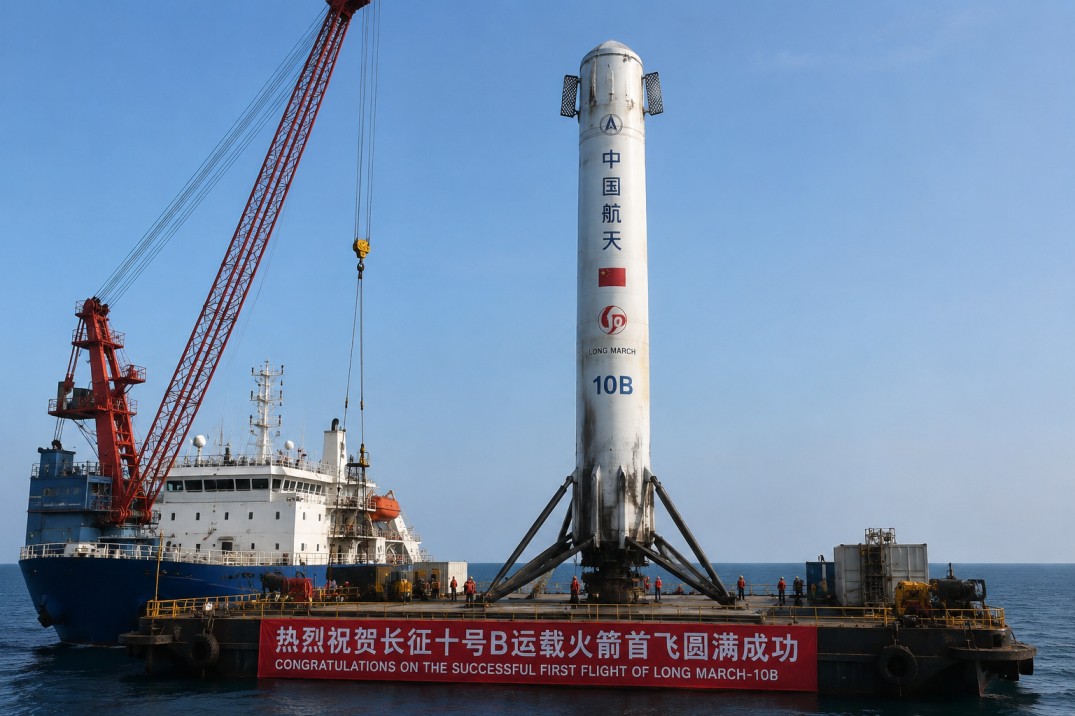
In a landmark achievement for China’s space endeavors, the nation has successfully retrieved its Long March 10B rocket after completing its inaugural orbital mission. This accomplishment elevates China to a position of prominence as the second country, following the United States, to develop dependable reusable orbital rocket technology.
The Long March 10B, standing 63.6 meters tall, was launched from the Hainan International Commercial Aerospace Launch Center. It was propelled by seven engines fueled by liquid oxygen and kerosene. Following the separation of the rocket’s stages, the second stage, equipped with a liquid oxygen-methane engine, continued on to successfully deliver a satellite into its intended orbit.
This mission also introduced a pioneering advancement in reusable space technology with the world’s first successful recovery of an orbital-class rocket using a wire arrestment recovery system. This innovative approach not only signifies a significant breakthrough in space technology but also underscores China’s growing capabilities and ambitions in the realm of space exploration.
The implications of this successful mission extend beyond technological prowess; they mark a strategic step forward in China’s expanding space program. By demonstrating the ability to recover and reuse rockets, China showcases its commitment to not only advancing its space technology but also potentially reducing the costs associated with space travel.
As China continues to make strides in its space efforts, this achievement highlights the country’s dedication to enhancing its space program and sets a new benchmark in global space exploration, reinforcing its position as a formidable player in the field.