
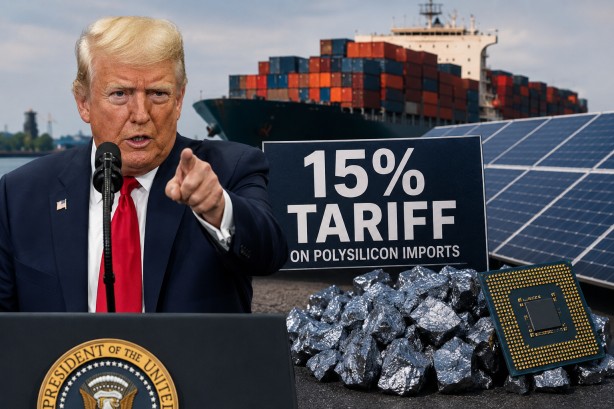
President Donald Trump has announced a 15% tariff on imported products that incorporate polysilicon, a crucial component in the production of semiconductors and solar panels. This tariff is set to be enforced from December 4 and is designed to bolster domestic manufacturing capabilities while decreasing reliance on imports from China, the leading global producer of polysilicon.
Polysilicon, an ultra-pure version of silicon, plays a vital role in creating semiconductors used in artificial intelligence systems and data centers, as well as in the manufacture of solar cells and panels. The imposed measures establish minimum import prices at $21 per kilogram for polysilicon, $100 per kilogram for polysilicon ingots and wafers, $0.22 per watt for solar cells, and $0.38 per watt for solar modules and panels.
The US administration has stated that these tariffs are intended to ensure the economic viability of domestic polysilicon production and to fortify supply chains crucial to both economic and national security. Currently, the US polysilicon industry is supported by two major production facilities managed by Hemlock Semiconductor in Michigan and Wacker Chemie in Tennessee. Additionally, the new policy provides a framework for incentivizing companies that invest in domestic polysilicon and related manufacturing infrastructure.
China has expressed criticism of the US decision, alleging that national security concerns are being misused to impose restrictions on Chinese businesses. The Chinese government has warned that this move toward increased protectionism might disrupt the trade relations between the two nations. Meanwhile, China continues to experience significant growth in its export sectors, particularly in electronics, artificial intelligence products, and other high-value manufacturing industries.