
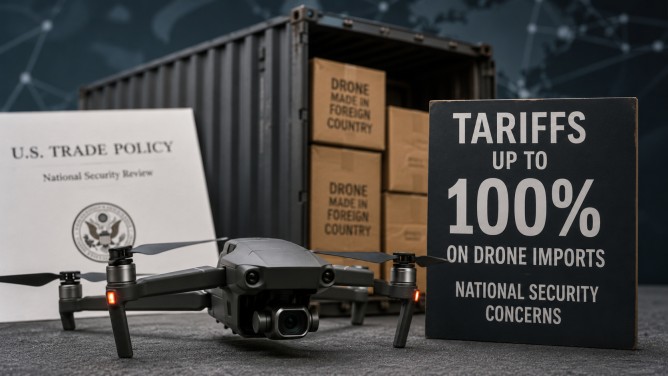
The United States has unveiled new tariffs targeting certain drones and their components, citing concerns over national security and the need to lessen reliance on supply chains heavily influenced by China. This initiative primarily affects unmanned aircraft systems, specifically larger drones exceeding 25 kilograms and those with capabilities relevant to national security, such as thermal cameras and docking stations. These items will face a steep 100% tariff, whereas smaller drones will incur a 25% tariff.
Furthermore, the tariffs extend to drones and components from key trading partners. Items originating from the European Union, Japan, Liechtenstein, South Korea, Switzerland, and Taiwan will be subjected to a 15% tariff. Meanwhile, imports from the United Kingdom will have a 10% tariff, contingent on the condition that the hardware, software, and technology are produced within these countries or the United States. These tariffs are slated to be implemented on September 3.
The White House has emphasized that these measures aim to bolster the U.S. defense and industrial sectors, promote domestic drone production, and stimulate job creation within the country. The overarching goal is to decrease dependency on foreign suppliers for these technologies. Currently, China holds a significant position in the global drone market. Shenzhen-based DJI, for example, captures a substantial portion of the U.S. commercial drone sector and has already encountered restrictions from the U.S. due to national security concerns.
U.S. officials have expressed worries that drones manufactured abroad could pose risks related to surveillance, sensitive data collection, and potential threats. In light of these concerns, the U.S. Federal Communications Commission has previously advocated for an increase in domestic production to mitigate such risks. The introduction of these tariffs occurs against a backdrop of ongoing trade and technology disputes between Washington and Beijing.
In response to these tensions, China has implemented its own restrictions impacting drone exports to the United States and has taken steps against several American companies. These developments underscore the complex dynamics between the two nations as they navigate issues related to trade and technological dominance.